


Impacts of a Walkable Community on Residents' Physical Activities
Project Lead: Xuemei Zhu, PhD
Description
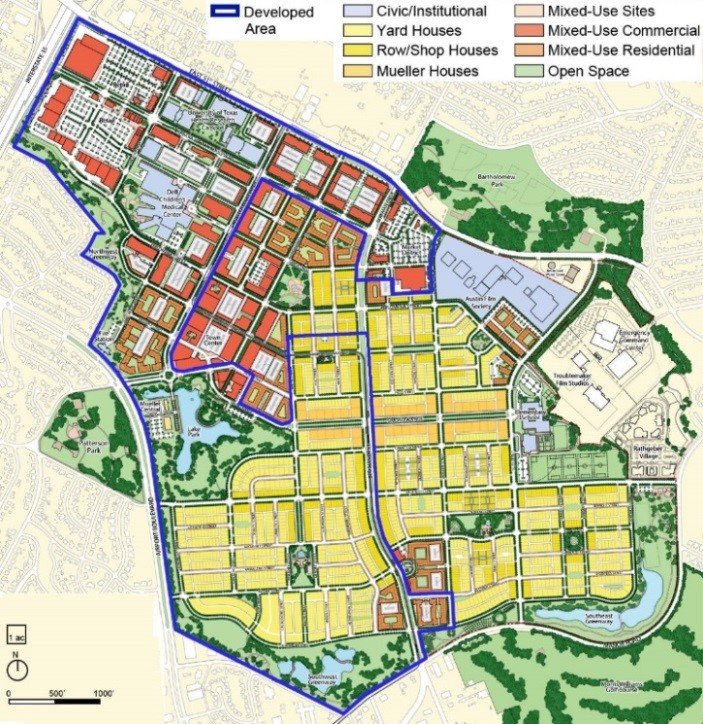 This case study examined changes in residents’ physical activities (PA), social interactions, and neighborhood cohesion after they moved to a walkable community—Mueller in Austin, Texas. It also compared such changes across different sub-groups.
A retrospective survey was administered to one adult in each participating household to collect pre- and post-move information about him/her and the oldest child in the family, if there was one.
Descriptive analysis was performed first and then paired t tests were used to examine pre-post differences. A total of 449 valid responses were received (response rate: 36.3%).
Highlights
After the move, Adults:
- The percentage of adults who had ≥5 days/week with ≥30 daily minutes of moderate PA increased from 34.4% to 45.8%; 64.8% reported "higher" levels of PA.
- There were significant increases (p<0.001) in total weekly minutes for bicycling (9.5 more minutes), total walking (32.1), and walking in the community (37.8); and a significant reduction (68.4 less minutes/week, p<0.001) in automobile use.
- the mean of total walking minutes was 142.4/week, which is close to the recommended level of 150 minutes of moderate PA per week.
- Significant increases in "saying hello to neighbors", "stopping and talking to neighbors", "socializing with neighbors at his/her/neighbor's home or somewhere else", and "seeking help from and exchange favor with neighbors" (7.0, 4.9, 2.1, and 1.2 more days/month, respectively; p<0.001).
- The percentages of residents using "parks or trails/paths in a park", "neighborhood streets and sidewalks", "greenways/trails/paths not in a park", and "homes" for PA improved by 32.1%, 9.8%, 22.7%, and 15.7%, respectively.
After the move, Children:
- From the responses, the researchers identified 52 children for whom both pre- and post-move data were available and the child was 2 years or older while leaving the previous neighborhood (mean age=8.7; 53.5% girls).
- 70.6% of the children had higher level of PA. The percentage of children reaching the PA guideline for ≥60 minutes of PA per day increased from 19.1% to 25.5%.
- Nine more minutes per day was observed for the time spent playing outdoors in the neighborhood on a typical non-school day (p<0.05).
- Locations of PA showed significant changes in the total number (1.9 more after the move, p<0.001) and the types being used.
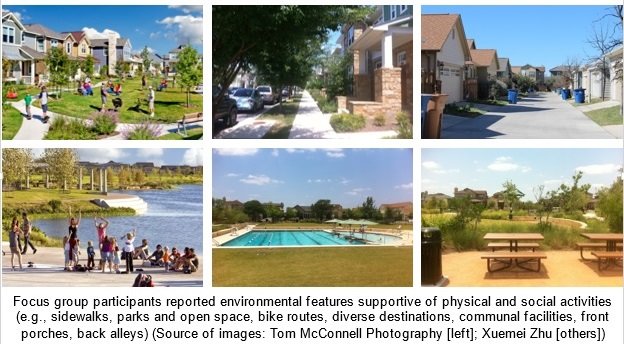
- "Parks or playgrounds in neighborhood" and "neighborhood streets and sidewalks" were the two most popular locations, followed by "biking/hiking/walking tails or paths", "swimming pool", "home's back alley", "friend's/relative's home", and "home's front porch".
Sample Presentations:
- Zhu X, Lu Z, Lee C, Mann G & Yu C. 2014. Impacting health: The impact of walkable community design on the health of Mueller, Texas residents. Presented at the AIA Design & Health Summit. Washington, DC: The American Institute of Architects (AIA).
- Zhu X, Lu Z, Yu C, Lee C & Mann, G. 2014. Do Walkable Communities Really Work? Health Impacts of Moving into a Walkable Community and Mechanisms for Health Behavior Change. Presented at the 2014 Active Living Research Conference, San Diego, CA.
- Zhu X, Lee C, Lu Z & Mann, G. 2013. Evaluating health impacts of walkable communities: Best practices and a toolkit for future design and research. Presented at the Design & Health World Congress and Exhibition, Brisbane, Australia.
Sample Publications:
- Zhu X, Yu C, Lee C, Lu Z & Mann G. 2014. A Retrospective Study on Changes in Residents’ Physical Activities, Social Interactions, and Neighborhood Cohesion after Moving to a Walkable Community. Preventive Medicine, 69(S):S93-S97.
- Zhu X, Lu Z, Lee C, Mann G & Yu C. 2014. Impacting health: The impact of walkable community design on the health of Mueller, Texas residents. In proceedings of the AIA Design & Health Summit. Washington, DC: The American Institute of Architects (AIA).
- Zhu X, Lu Z, Yu C, Lee C & Mann G. 2013. Walkable communities: Impacts on residents’ physical and social health. World Health Design, 2013(7), 68-75.
Additional Information:
To learn more, please email the Global Obesity Prevention Center at Johns Hopkins here.